Ink Color Challenge
A Stroop-style task: tap the ink color of a color word and ignore what the word says. Classic interference control.
How it works, with a real roundResearch · Stroop, 1935
Play a fast mix of logic, memory, focus, and visual puzzles. Every workout adapts as you improve and takes about four minutes.
Built for iPhone · Entertainment only — not an IQ or medical test.
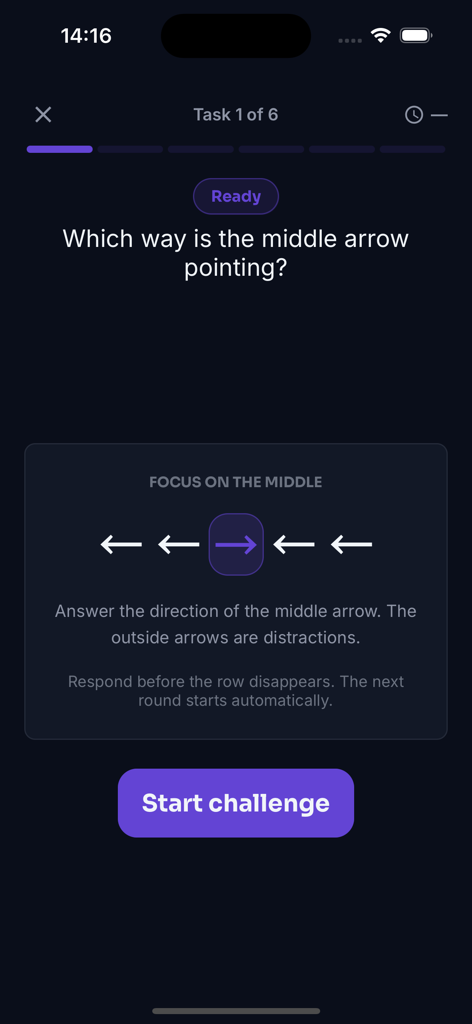
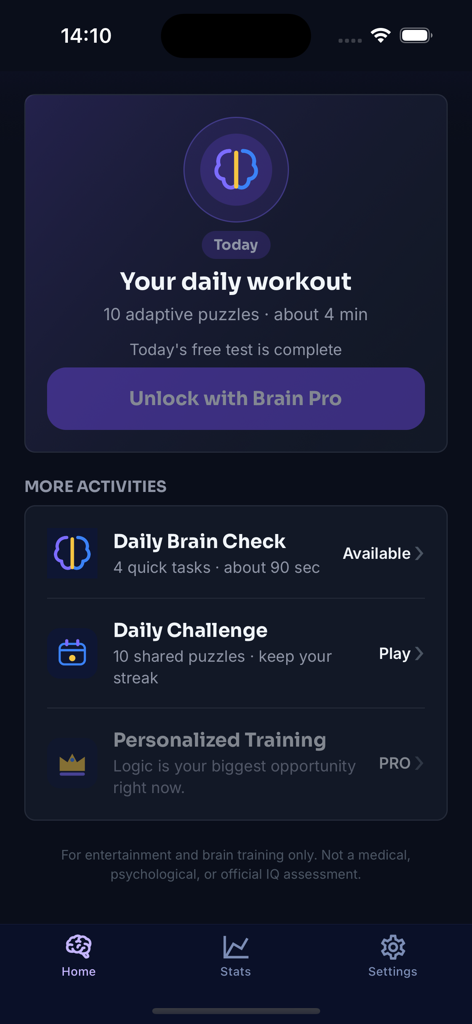
Start with a balanced 10-puzzle workout, take a 90-second Brain Check, or play the shared Daily Challenge. Each mode is short enough to fit into a real day.
Spot patterns, recall sequences, ignore distractions, and rotate objects in your head. Clear instructions come first; then the game asks for accuracy, speed, or both.
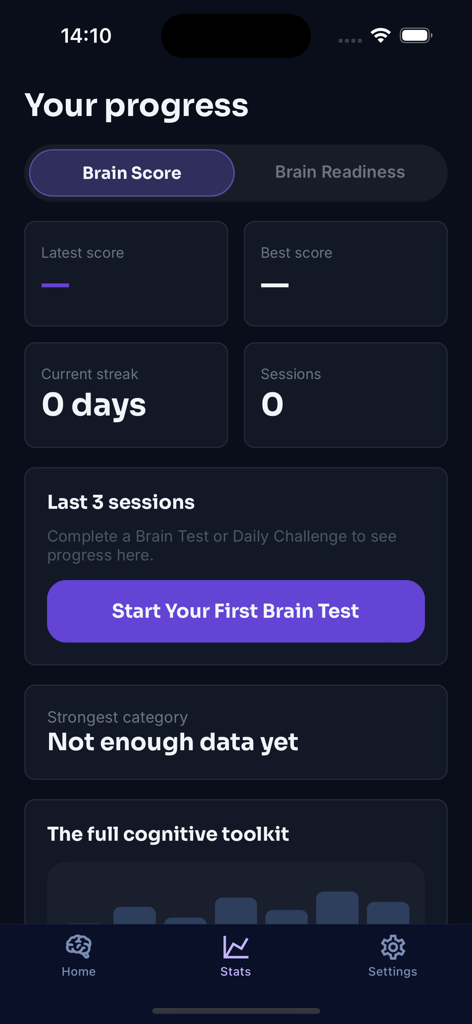
Brain Score summarizes a session while Brain Readiness follows your recent consistency. Category trends help you notice what is improving without turning practice into homework.
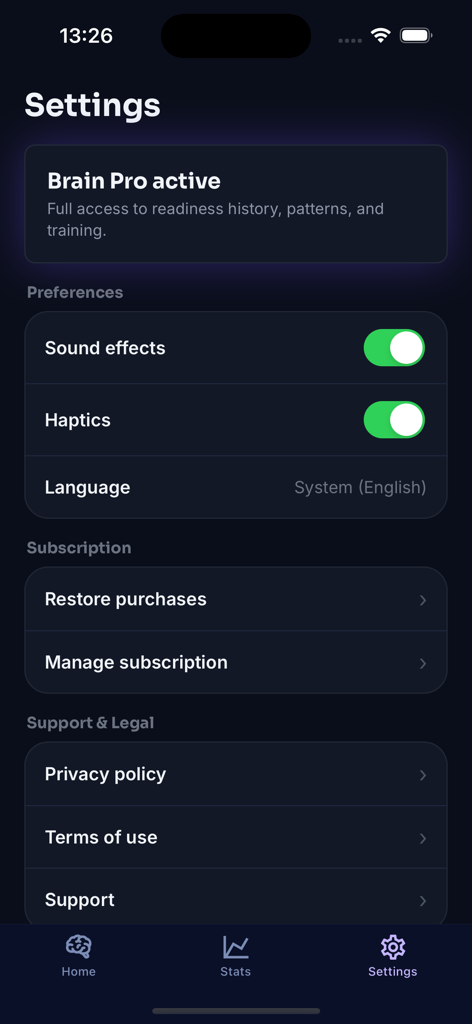
Brain Pro unlocks unlimited workouts, personalized training, and complete progress history. The free version still gives you a meaningful daily session before you decide.
Brain Score combines accuracy and response time into one session result. It gives you a simple benchmark without pretending to be a clinical IQ score.
Each correct answer earns a dependable base score, so careful play is always worth more than a rushed guess.
Fast correct answers can add up to six points, rewarding fluency without making every puzzle a reaction test.
Every mixed workout uses the same 0–160 range, making recent sessions easy to compare at a glance.
Sessions mix short challenges drawn from paradigms used in cognitive psychology — Stroop, flanker, spatial span, mental rotation, and more. Each card explains what you do in the app and points to related research.
A Stroop-style task: tap the ink color of a color word and ignore what the word says. Classic interference control.
How it works, with a real roundResearch · Stroop, 1935A flanker-style task: report the direction of the middle arrow while surrounding arrows try to pull your attention away.
How it works, with a real roundResearch · Eriksen & Eriksen, 1974A go/no-go challenge: respond quickly to most shapes, then withhold the response when a forbidden target appears.
Research · Diamond, 2013 (review)Corsi-inspired spatial span: watch positions light up, then tap them back in order. Trains visuospatial working memory.
How it works, with a real roundResearch · Kessels et al., 2000Hold digits or symbols in mind, update them, and decide whether the current item matches one shown N steps earlier.
How it works, with a real roundResearch · Owen et al., 2005Decide whether two figures are the same object after rotation — not a mirror image. Built on classic mental-rotation work.
How it works, with a real roundResearch · Shepard & Metzler, 1971Find the rule in number or shape progressions and complete the next step. Close to inductive-reasoning exercises used in cognitive training trials.
Research · ACTIVE trial · Ball et al., 2002Solve timed arithmetic or spot a target among distractors under time pressure — processing speed and selective attention.
Research · ACTIVE 10-year follow-upEach puzzle type keeps its own level on a scale from 1 to 10, so a strong run in one game does not make another one harder. After every round, the app looks at your recent results for that type.
A steady run of accurate rounds played at a good pace moves the level up one step. A run of rounds with half or fewer answers correct moves it down one step. Quick guesses that turn out wrong never count toward a step up.
The aim is to keep each puzzle challenging but playable. The level describes the game you get, not your intelligence, memory, or health.
These papers describe the task families behind Brain Puzzle and what large trials found about cognitive practice. They do not claim that this app is a clinical assessment or that playing it raises IQ.
Foundational paper for color–word interference — the basis of our Ink Color Challenge.
Introduced the flanker paradigm used in Arrow Focus Challenge.
Open-access overview of working memory, inhibition, and cognitive flexibility — including Stroop, flanker, and go/no-go.
Showed that comparing rotated shapes takes time proportional to the angle — the core idea behind Mental Rotation.
ACTIVE trial: training memory, reasoning, or processing speed improved the targeted abilities vs. controls.
Long-term follow-up of ACTIVE — durable effects on trained cognitive domains for many participants.
Important caution: working-memory training often shows near transfer; far transfer to general intelligence is limited.
Meta-analysis of computerized cognitive training — modest domain-specific gains when training is well designed.
Bottom line from the literature: practicing a specific cognitive task usually improves that task (near transfer). Broad gains in everyday intelligence or school/work outcomes are much weaker and still debated. Brain Puzzle is designed for short, enjoyable practice — not diagnosis or therapy.
Upgrade inside the app with monthly or yearly plans. Billing is handled securely by the App Store or Google Play — cancel anytime in your store account settings.
Free players get one brain test per UTC day. Brain Pro removes the daily cap so you can practice anytime.
Five top-level puzzles every day, with a score and a day streak. A new challenge unlocks at midnight.
See your complete score history, category performance charts, and 7-day / 30-day trends.
Get a custom 10-puzzle training plan focused on your weakest categories based on recent performance.
View per-category accuracy, speed, and task-by-task details on every results screen.
Subscriptions are managed through Apple or Google. Restore purchases anytime from Settings.
Download Brain Puzzle now on iPhone and start training your mind.