
Remember the path, then tap it back
On a grid of blocks, a few light up one after another. When the sequence finishes, you tap the same blocks in the same order.
Built for iPhone. Entertainment only, not an IQ or medical test.
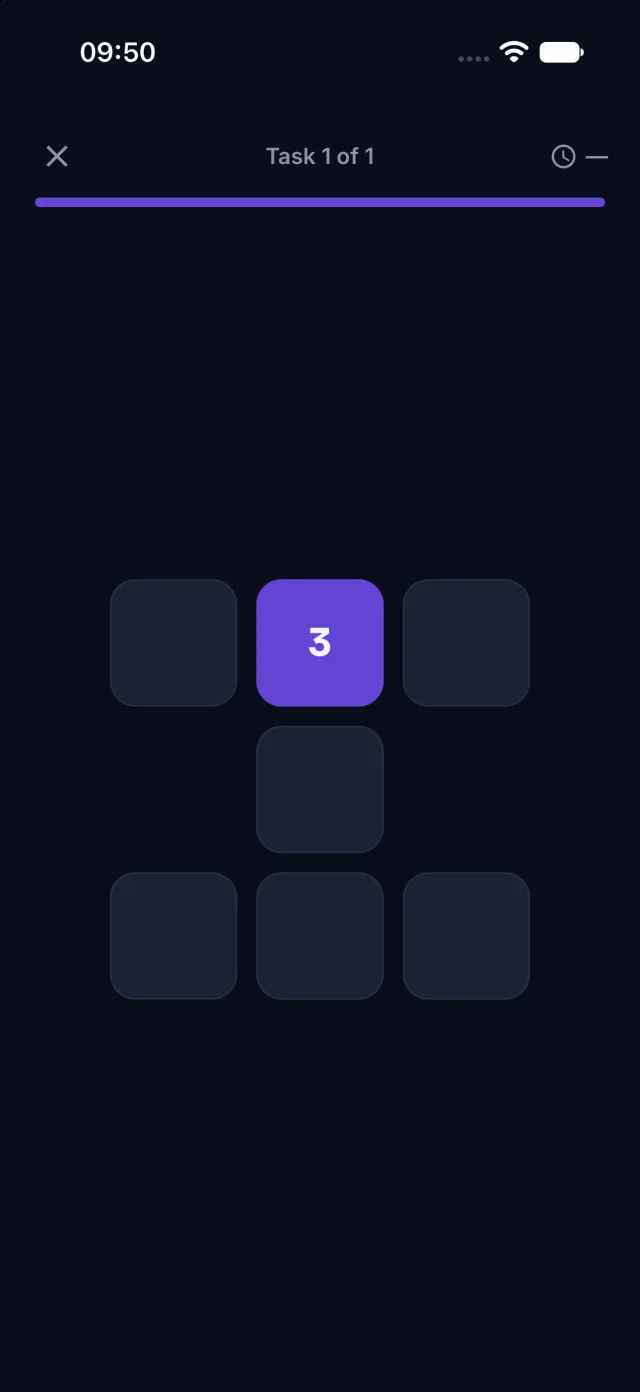
What a round looks like
Three blocks flash: top left, bottom right, then the middle. You tap those three blocks in that order. At higher levels the sequence gets longer.
Where the idea comes from
Block Sequence Challenge is inspired by this research:
- Kessels, R. P. C., van Zandvoort, M. J. E., Postma, A., Kappelle, L. J., & de Haan, E. H. F. 2000. The Corsi Block-Tapping Task: standardization and normative data. Applied Neuropsychology.Describes the block-tapping procedure that goes back to Corsi, 1972, and how researchers run it.
Brain Puzzle uses original layouts and sequences in that general format. It is not a standardized clinical battery, and a score in the app is not a memory diagnosis.
For what large studies found about brain training, including the limits, see what the science actually says.
How it plays in Brain Puzzle
Each round shows one sequence and then waits for your taps. We describe only how the game gets harder or easier, not any promised change in everyday memory.
Difficulty that follows you
Each puzzle type keeps its own level on a scale from 1 to 10, so a strong run in one game does not make another one harder. After every round, the app looks at your recent results for that type.
A steady run of accurate rounds played at a good pace moves the level up one step. A run of rounds with half or fewer answers correct moves it down one step. Quick guesses that turn out wrong never count toward a step up.
The aim is to keep each puzzle challenging but playable. The level describes the game you get, not your intelligence, memory, or health.
More puzzle types in Brain Puzzle
Try Block Sequence Challenge on iPhone
Get Brain Puzzle: Brain Training on the App Store. It shows up as one of the puzzles in your workouts.